
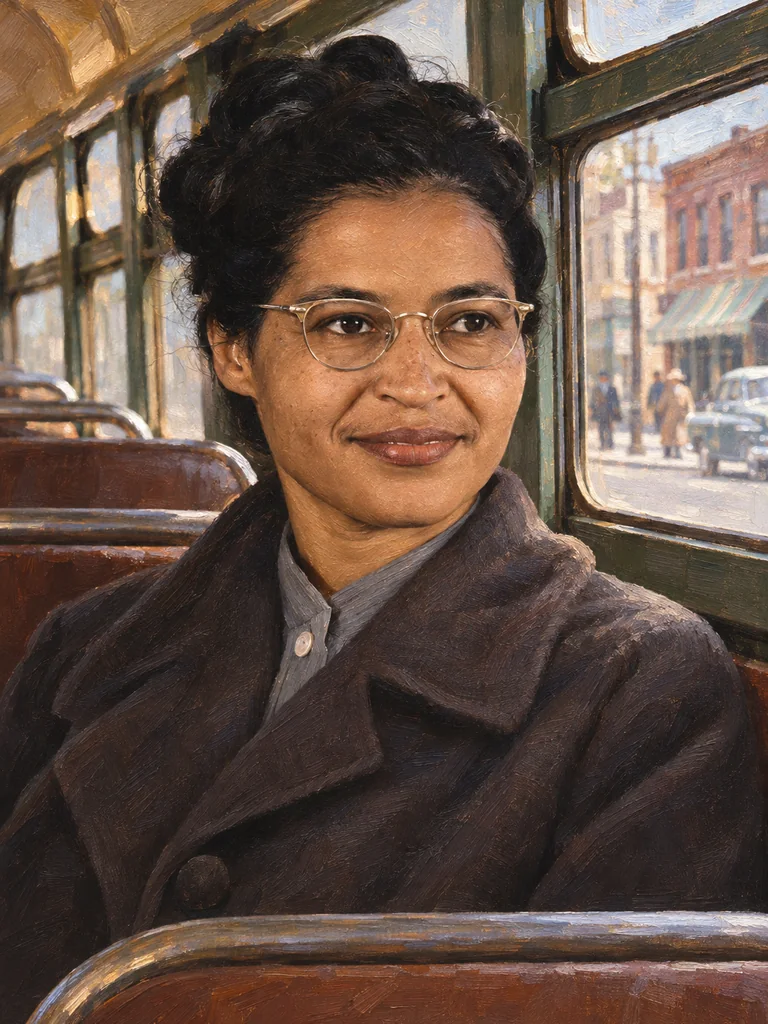
On December 1, 1955, in Montgomery, a seamstress refused to give up her seat on a bus. Her arrest sparked 381 days of boycott and propelled a young pastor named Martin Luther King.
Rosa Louise McCauley was born on February 4, 1913, in Tuskegee, Alabama, in a South where segregation governed every gesture of daily life. In 1932, she married Raymond Parks, a civil rights activist. In 1943, she joined the Montgomery branch of the NAACP, the National Association for the Advancement of Colored People, and became its secretary. She investigated racist violence, and saw up close the injustice that the law protected.
Her act in 1955 had a long history. As early as 1943, a bus driver, James F. Blake, had already forced her off his vehicle: for twelve years, she avoided his buses. In the summer of 1955, she received training in nonviolent struggle at the Highlander Folk School in Tennessee.
On December 1, 1955, in Montgomery, after her workday in a department store, she boarded a bus. The driver was James Blake again. When he ordered her to give up her seat to a white passenger, she refused. She was arrested. Later, she would correct the legend of a seamstress who was simply exhausted: “The only tired I was, was tired of giving in.”
Her arrest set fire to a community ready to act. On December 5, the day she was tried and fined, almost all the city's Black residents boycotted the buses. That very evening, a 26-year-old young pastor was chosen to lead the movement: Martin Luther King. For 381 days, people walked, shared cars, and held firm despite threats and bombs. In 1956, the federal courts declared segregation on buses unconstitutional, and the Supreme Court upheld the decision. On December 20, 1956, the boycott ended.
Her courage came at a price. Dismissed from her job and threatened, she left Montgomery in 1957 for Detroit, where she later worked for years with Congressman John Conyers, and continued the fight for equality.
The honors came with time: the Presidential Medal of Freedom in 1996, the Congressional Gold Medal in 1999. When she died on October 24, 2005, at the age of 92, she became the first woman to lie in honor in the rotunda of the Capitol in Washington. It had all begun with a quiet refusal, on a bus in Montgomery.
Key dates
- February 4, 1913: born in Tuskegee, Alabama
- 1943: secretary of the Montgomery branch of the NAACP
- December 1, 1955: refused to give up her seat on a Montgomery bus
- 1955-1956: 381 days of bus boycott, led in particular by Martin Luther King
- 1956: segregation on buses was declared unconstitutional
- 1999: Congressional Gold Medal of the United States
- 2005: first woman to lie in honor in the Capitol rotunda
Our sources
- Wikipédia : Rosa Parks
- Stanford, King Institute : le boycott des bus de Montgomery
- Chambre des représentants des États-Unis : l'hommage à Rosa Parks
Our stories are true and our sources are cited. Each story is checked before publication; if you spot an inaccuracy, write to us on our social networks. Translated from the original French story.


